Fleetwood Mac Never Going Back Again David Crain
| Rumours | ||||
|---|---|---|---|---|
 | ||||
| Studio album by Fleetwood Mac | ||||
| Released | iv Feb 1977 (1977-02-04) | |||
| Recorded | February–Baronial 1976 | |||
| Studio |
| |||
| Genre |
| |||
| Length | 38:55 | |||
| Label | Warner Bros. | |||
| Producer |
| |||
| Fleetwood Mac chronology | ||||
| ||||
| Singles from Rumours | ||||
| ||||
Rumours is the eleventh studio album by British-American rock band Fleetwood Mac, released on 4 February 1977 by Warner Bros. Records. Largely recorded in California in 1976, it was produced by the band with Ken Caillat and Richard Dashut. The ring wanted to expand on the commercial success of their self-titled 1975 album. The group recorded the album in the aftermath of relationship breakups among its members and heavy drug utilise, both of which shaped the album'south lyrics.
Recorded with the intention of making "a pop anthology", the album's music included considerable pop stone sounds, characterized by accented rhythms and electrical keyboards such as the Fender Rhodes and Hammond B3 organ. The album was postponed by delays in the mixing process. Following the anthology's release, Fleetwood Mac undertook worldwide promotional tours. Rumours became the band's first number-one album on the UK Albums Chart and as well topped the U.s.a. Billboard 200. The songs "Go Your Own Way", "Dreams", "Don't Terminate", and "You Make Loving Fun" were released as singles, all of which reached the US top 10, with "Dreams" reaching number one.
Rumours was an instant commercial success, selling over 10 million copies worldwide within just a month of its release. Information technology garnered widespread acclaim from critics, with praise centred on its product quality and harmonies, which frequently relied on the interplay among three vocalists and has inspired the work of musical acts in unlike genres. It won Album of the Year at the 1977 Grammy Awards. It has sold over twoscore million copies worldwide, making it ane of the best-selling albums of all time. Domestically, it has received Diamond certifications in several countries, including the UK, Canada, and Australia, and has been certified 20× platinum in the U.s.a..
Often considered Fleetwood Mac's magnum opus, Rumours has often been cited as one of the greatest albums of all time. In 2004, Rumours was remastered and reissued with the add-on of "Silver Springs", which had been excluded from the original, and a bonus CD of outtakes from the recording sessions. In 2003, it was inducted into the Grammy Hall of Fame.[1] In 2018, information technology was selected for preservation in the National Recording Registry, being deemed "culturally, historically, or artistically pregnant" by the Library of Congress.[2] In 2020, Rumours was rated the 7th-greatest album of all time in Rolling Stone 'due south list of the "500 Greatest Albums of All Time".[3]
Background [edit]
In July 1975, Fleetwood Mac's eponymous 10th album was released to not bad commercial success, reaching No. ane in the U.Southward. in 1976. The tape'south biggest hit single, "Rhiannon", gave the ring extensive radio exposure. At the time, Fleetwood Mac's line-up consisted of guitarist and vocalist Lindsey Buckingham, drummer Mick Fleetwood, keyboard actor and vocalist Christine McVie, bass guitarist John McVie, and vocaliser Stevie Nicks. After six months of non-end touring, the McVies divorced, ending 8 years of marriage.[4] [5] The couple stopped talking to each other socially and discussed only musical matters.[6] Buckingham and Nicks—who had joined the ring before 1975's Fleetwood Mac after guitarist Bob Welch had left[7]—were having an on/off relationship that led them to fight frequently. The duo'southward arguments stopped but when they worked on songs together.[8] Fleetwood faced domestic problems of his own after discovering that his wife Jenny, mother of his two children, had had an affair with his all-time friend.[ix]
Press intrusions into the band members' lives led to inaccurate stories. Christine McVie was reported to have been in the infirmary with a serious illness, while Buckingham and Nicks were declared the parents of Fleetwood's daughter Lucy after being photographed with her. The press also wrote about a rumoured render of original Fleetwood Mac members Peter Green, Danny Kirwan, and Jeremy Spencer for a 10th anniversary tour.[ten] Despite false reports, the band did not change its lineup, although its members had no time to come to terms with the separations before recording for a new album began.[6] Fleetwood has noted the "tremendous emotional sacrifices" made by everyone only to attend studio piece of work.[11] In early 1976, Fleetwood Mac crafted some new tracks in Florida.[12] Founding members Fleetwood and John McVie chose to dispense with the services of their previous producer, Keith Olsen, because he favoured a lower accent on the rhythm department. The duo formed a company chosen Seedy Direction to represent the band's interests.[13]
Recording [edit]

Rumours was largely recorded in Sausalito'due south Record Plant, a wooden structure with few windows, located at 2200 Marinship Style.

Fleetwood Mac'southward female members lived in two of Sausalito's seafront properties, while the men resided at the Tape Plant's hillside accommodation.
In February 1976, Fleetwood Mac convened at the Record Plant in Sausalito, California, with hired engineers Ken Caillat and Richard Dashut. Production duties were shared by the iii parties, while the more technically practiced Caillat was responsible for most of the technology; he took a leave of absence from Wally Heider Studios in Los Angeles on the premise that Fleetwood Mac would eventually apply their facilities.[14] The gear up-up in Sausalito included a number of pocket-size recording rooms in a large, windowless, wooden building. Most band members complained about the studio and wanted to record at their homes, simply Fleetwood did non allow whatsoever moves.[15] Christine McVie and Nicks decided to alive in two condominiums near the city's harbour, while the male person contingent stayed at the studio'southward gild in the adjacent hills.[sixteen] Recording occurred in a six-by-nine-metre (twenty by 30 ft) room which included a 3M 24-track tape automobile, a range of loftier-quality microphones, and an API mixing console with 550A equalisers; the latter were used to control frequency differences or a runway'south timbre. Although Caillat was impressed with the set up-up, he felt that the room lacked ambience because of its "very dead speakers" and large amounts of soundproofing.[14]
The record's working championship in Sausalito was Yesterday's Gone.[17] Buckingham took charge of the studio sessions to make "a pop album".[18] Co-ordinate to Dashut, while Fleetwood and the McVies came from an improvisational dejection-rock background, the guitarist understood "the craft of tape making".[19] During the formative stages of compositions, Buckingham and Christine McVie played guitar and piano together to create the album's basic structures. The latter was the merely classically trained musician in Fleetwood Mac, only both shared a like sense of musicality.[20] When the band jammed, Fleetwood frequently played his drum kit outside the studio's sectionalization screen to meliorate gauge Caillat's and Dashut'south reactions to the music'southward groove.[21] Baffles were placed effectually the drums and around John McVie, who played his bass guitar facing Fleetwood. Buckingham performed close to the rhythm department, while Christine McVie's keyboards were kept away from the drum kit. Caillat and Dashut spent about ix days working with a range of microphones and amplifiers to get a larger sound, earlier discovering they could adjust the sound effectively on the API mixing console.[fourteen]
As the studio sessions progressed, the band members' new intimate relationships that formed afterwards diverse separations started to take a negative effect on Fleetwood Mac.[22] [23] The musicians did non run into or socialise later on their daily work at the Record Plant. At the time, the hippie movement notwithstanding affected Sausalito'south culture and drugs were readily bachelor. Open-ended budgets enabled the band and the engineers to become self-indulgent;[fifteen] [24] sleepless nights and the all-encompassing apply of cocaine marked much of the album's production.[11] Chris Rock, i of the Record Plant's owners, indicated in 1997 that Fleetwood Mac brought "excess at its well-nigh excessive" by taking over the studio for long and extremely expensive sessions; he stated, "The band would come in at 7 at night, have a big feast, party till 1 or two in the morning, and and so when they were so whacked-out they couldn't do anything, they'd offset recording".[25]
"Trauma, Trau-ma. The sessions were similar a cocktail party every night—people everywhere. We concluded upward staying in these weird hospital rooms ... and of course John and me were not exactly the best of friends."[4]
—Christine McVie, on the emotional strain when making Rumours in Sausalito
Nicks has suggested that Fleetwood Mac created the best music when in the worst shape,[24] while, according to Buckingham, the tensions between ring members informed the recording process and led to "the whole being more than the sum of the parts".[23] The couple's work became "bittersweet" after their final split, although Buckingham still had a skill for taking Nicks' tracks and "making them beautiful".[26] The vocal harmonies between the duo and Christine McVie worked well and were captured using the best microphones available.[14] Nicks' lyrical focus allowed the instrumentals in the songs that she wrote to exist looser and more than abstract.[27] According to Dashut, all the recordings captured "emotion and feeling without a center man ... or tempering".[9] John McVie tended to clash with Buckingham about the make-up of songs, simply both acknowledge to achieving good outcomes.[28] Christine McVie's "Songbird", which Caillat felt needed a concert hall's ambience, was recorded during an all-nighttime session at Zellerbach Auditorium in Berkeley, beyond San Francisco Bay from Sausalito.[29]
Following over 2 months in Sausalito, Fleetwood arranged a ten-day tour to give the band a pause and get fan feedback. Afterwards the concerts, recording resumed at venues in Los Angeles,[thirteen] including Wally Heider Studios. Christine McVie and Nicks did non attend most of the sessions and took time off until they were needed to record any remaining vocals. The rest of Fleetwood Mac, with Caillat and Dashut, struggled to finalise the overdubbing and mixing of Rumours after the Sausalito tapes were damaged by repeated use during recording; the kick and snare pulsate sound tracks sounded "lifeless".[fourteen] A sell-out autumn tour of the United states was cancelled to allow the completion of the album,[4] whose scheduled release date of September 1976 was pushed back.[30] A specialist was hired to rectify the Sausalito tapes using a vari-speed oscillator. Through a pair of headphones which played the damaged tapes in his left ear and the safety master recordings in his right, he converged their respective speeds aided by the timings provided past the snare and howdy-hat sound tracks.[fourteen] Fleetwood Mac and their co-producers wanted a "no-filler" terminal product, in which every track seemed a potential single. After the final mastering phase and hearing the songs dorsum-to-dorsum, the band members sensed they had recorded something "pretty powerful".[31]
Promotion and release [edit]

In autumn 1976, while nonetheless recording, Fleetwood Mac showcased tracks from Rumours at the Universal Amphitheatre in Los Angeles.[iv] John McVie suggested the album title to the band because he felt the members were writing "journals and diaries" about each other through music.[32] Warner Bros. confirmed the release details to the printing in December and chose "Go Your Own Way" as a December 1976 promotional single.[33] [34] The label's ambitious marketing of 1975's Fleetwood Mac, in which links with dozens of FM and AM radio stations were formed across America, aided the promotion of Rumours.[35] At the fourth dimension, the album's advance society of 800,000 copies was the largest in Warner Bros.' history.[36]
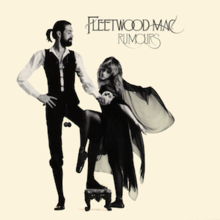
Rumours was released on 4 Feb 1977 in the US, and a week later in the UK.[37] [38] The front cover features a stylised shot of Fleetwood and Nicks dressed in her "Rhiannon" stage persona, while the back has a montage of band portraits; all the photographs were taken past Herbert Worthington.[21] On 28 February 1977, after rehearsing at SIR Studios in Los Angeles, Fleetwood Mac started a seven-calendar month-long promotional tour of America.[37] Nicks has noted that, afterwards performing mostly Rumours songs during gigs, the band initially encountered poor receptions from fans who were not accustomed to the new material.[39] A one-off March operation at a benefit concert for United States Senator Birch Bayh in Indiana was followed by a short European tour of the UK, the Netherlands, French republic, and Deutschland in April.[four] [40] Nigel Williamson of Uncut called Fleetwood Mac's performances "stone's greatest lather opera".[41] "Dreams", released in March 1977, became the band's only number 1 on the U.s.a. Billboard Hot 100 in June.[42]
Composition [edit]
Lyrics [edit]
Fleetwood Mac's main writers — Buckingham, Christine McVie and Nicks — worked individually on songs only sometimes shared lyrics with each other. "The Concatenation" is the only rails on which all members, including Fleetwood and John McVie, collaborated. All songs on Rumours concern personal, often troubled relationships.[21] Co-ordinate to Christine McVie, the fact that the lyricists were focusing on the diverse separations became credible to the band only in hindsight.[32] "You Make Loving Fun" is about her swain, Fleetwood Mac'southward lighting director, whom she dated later splitting from John.[22] Nicks' "Dreams" details a breakup and has a hopeful message, while Buckingham'southward like effort in "Become Your Ain Way" is more pessimistic.[43] Later a short fling with a New England woman, he was inspired to write "Never Going Back Again", a vocal about the illusion of thinking that sadness will never occur again one time content with life. The lines "Been down one time/Been down two times" refer to the lyricist'south efforts when persuading the woman to give him a chance.[21]
"Don't Cease", written by Christine McVie, is a song most optimism. She noted that Buckingham helped her craft the verses because their personal sensibilities overlapped.[21] McVie's next rails, "Songbird", features more than introspective lyrics nearly "nobody and everybody" in the form of "a picayune prayer".[44] "Oh Daddy", the last McVie song on the album, was written about Fleetwood and his wife Jenny Boyd, who had just got back together.[45] [46] [47] The band's nickname for Fleetwood was "the Large Daddy".[21] McVie commented that the writing is slightly sarcastic and focuses on the drummer'south direction for Fleetwood Mac, which always turned out to be right. Nicks provided the final lines "And I can't walk away from you, babe/If I tried". Her ain vocal "Gold Grit Woman" is inspired past Los Angeles and the hardship encountered in such a urban center.[21] After struggling with the rock lifestyle, Nicks became addicted to cocaine; the lyrics address her belief in "keeping going".[48]
Music [edit]
Featuring a soft rock and popular rock audio,[49] [50] Rumours is congenital effectually a mix of acoustic and electrical instrumentation. Buckingham's guitar work and Christine McVie's use of Fender Rhodes piano or Hammond B-3 organ are nowadays on all but two tracks. The record oftentimes includes stressed drum sounds and distinctive percussion such as congas and maracas. It opens with "2d Hand News", originally an acoustic demo titled "Strummer". Afterward hearing Bee Gees' "Jive Talkin'", Buckingham and co-producer Dashut built up the song with four audio tracks of electric guitar and the use of chair percussion to evoke Celtic stone. "Dreams" includes "ethereal spaces" and a recurring two notation pattern on the bass guitar.[21] Nicks wrote the song in an afternoon and led the vocals, while the band played around her. The third rail on Rumours, "Never Going Back Again", began as "Brushes", a simple acoustic guitar tune played by Buckingham, with snare rolls by Fleetwood using brushes; the band added vocals and farther instrumental audio tracks to brand it more layered.[51] [52] Inspired past triple step dancing patterns, "Don't End" includes both conventional acoustic and tack piano. In the latter musical instrument, nails are placed on the points where the hammers hitting the strings, producing a more percussive sound. "Go Your Own Manner" is more than guitar-oriented and has a four-to-the-floor dance vanquish influenced by The Rolling Stones' "Street Fighting Man". The album's footstep slows down with "Songbird", conceived solely by Christine McVie using a nine-pes Steinway piano.[21]

Side two of Rumours begins with "The Chain", i of the record's nigh complicated compositions. A Christine McVie demo, "Go along Me There",[21] and a Nicks song were re-cut in the studio and were heavily edited to form parts of the rails.[53] The whole of the band crafted the remainder using an approach alike to creating a moving picture score; John McVie provided a prominent solo using a fretless bass guitar, which marked a speeding upward in tempo and the start of the song's concluding third. Inspired by R&B, "You Brand Loving Fun" has a simpler limerick and features a clavinet, a special type of keyboard instrument, while the rhythm section plays interlocking notes and beats. The ninth track on Rumours, "I Don't Desire to Know", makes employ of a twelve cord guitar and harmonising vocals. Influenced past the music of Buddy Holly, Buckingham and Nicks created it in 1974 before they were in Fleetwood Mac. "Oh Daddy" was crafted spontaneously and includes improvised bass guitar patterns from John McVie and keyboard blips from Christine McVie. The anthology ends with "Gold Grit Adult female", a song inspired by free jazz, which has music from a harpsichord, a Fender Stratocaster guitar, and a dobro, an acoustic guitar whose audio is produced past one or more metal cones.[21]
Disquisitional reception [edit]
| Aggregate scores | |
|---|---|
| Source | Rating |
| Metacritic | 99/100 (deluxe version) [54] |
| Review scores | |
| Source | Rating |
| AllMusic |  [55] [55] |
| Blender | [56] |
| Christgau's Tape Guide | A[57] |
| Entertainment Weekly | A[58] |
| The Independent | [59] |
| Mojo | [60] |
| Pitchfork | x/10[61] |
| Rolling Rock | [62] |
| The Rolling Stone Anthology Guide | [63] |
| Uncut | [64] |
Rumours has been acclaimed by music critics since its release. Robert Christgau, reviewing in The Village Voice, described it every bit "more than consistent and more eccentric" than its predecessor. He added that it "jumps right out of the speakers at you".[65] Rolling Stone mag's John Swenson believed the interplay among the three vocalists was 1 of the album's nearly pleasing elements; he stated, "Despite the interminable delay in finishing the record, Rumours proves that the success of Fleetwood Mac was no fluke."[66] In a review for The New York Times, John Rockwell said the album is "a delightful disk, and ane hopes the public thinks so, likewise",[67] while Dave Marsh of the St. Petersburg Times claimed the songs are "as grandly glossy as anything right now".[68] Robert Hilburn was less receptive and called Rumours a "frustratingly uneven" record in his review for the Los Angeles Times,[69] while Juan Rodriguez of The Gazette suggested that, while the music is "crisper and clearer", Fleetwood Mac's ideas are "slightly more muddled".[70] The album finished fourth in The Village Vocalism 's 1977 Pazz & Jop critics' poll, which aggregated the votes of hundreds of prominent reviewers.[71]
In a retrospective review, AllMusic editor Stephen Thomas Erlewine gave Rumours v stars and noted that, regardless of the voyeuristic element, the record was "an unparalleled blockbuster" because of the music's quality; he concluded, "Each tune, each phrase regains its raw, immediate emotional power—which is why Rumours touched a nerve upon its 1977 release, and has since transcended its era to exist one of the greatest, well-nigh compelling pop albums of all time."[55] According to Slant Magazine 's Barry Walsh, Fleetwood Mac drew on romantic dysfunction and personal turmoil to create a timeless, v-star record,[72] while Andy Gill of The Independent claimed it "represents, forth with The Eagles Greatest Hits, the high-water marker of America'southward Seventies rock-culture expansion, the quintessence of a counter-cultural mindset lured into coke-fuelled hedonism".[59] In 2007, the BBC'due south Daryl Easlea labelled the sonic results as "near perfect", "like a thousand angels kissing yous sweetly on the brow",[73] while Patrick McKay of Stylus Magazine wrote, "What distinguishes Rumours—what makes it art—is the contradiction between its cheerful surface and its anguished heart. Hither is a radio-friendly record about anger, recrimination, and loss."[74]
Commercial performance [edit]
Rumours was a huge commercial success and became Fleetwood Mac's second US number-1 record, following the 1975 eponymous release.[42] It stayed at the top of the Billboard 200 for 31 non-consecutive weeks,[17] while also reaching number ane in the United kingdom, Australia, Canada,[40] and New Zealand.[75] In May 2011 it re-entered Billboard 200 chart at number 11, and the Australian ARIA chart at number ii, due to several songs from the anthology being used for the "Rumours" episode of the American Boob tube series Glee.[76] [77] It re-entered the Billboard 200 top ten in October 2020 in the wake of a viral TikTok by Nathan Apodaca which showed him skateboarding while "Dreams" played, even prompting Mick Fleetwood and Stevie Nicks to create similar videos.[78] [79] The album was certified platinum in America and the UK within months of release subsequently one million units and 300,000 units were shipped, respectively.[eighty] [81] All three major U.s.a. merchandise publications—Billboard, Cash Box, and Tape Globe—named information technology Album of the Year for 1977.[82] After a debut at number seven, Rumours peaked at the pinnacle of the UK Albums Chart in January 1978, becoming Fleetwood Mac's start number one anthology in the country.[83] In February, the band and co-producers Caillat and Dashut won the 1978 Grammy Award for Anthology of the Yr.[42] By March, the anthology had sold over 10 million copies worldwide, including over eight 1000000 in the Us alone.[82]
By 1980, thirteen million copies of Rumours had been sold worldwide.[84] Equally of 2017, sales were over 40 1000000 copies.[85] [45] As of October 2019[update], Rumours has spent 800 weeks in the UK Height 100 album chart and is the 11th best-selling album in UK history and is certified 14× platinum by the British Phonographic Industry, the equivalent of 4.2 million units shipped.[81] The record has received a Diamond Award from the Recording Industry Association of America for a 20× platinum certification or xx one thousand thousand copies shipped, making it, as of 2021[update], tied for the eleventh highest certified album in United states of america history (by number of copies shipped).[86] Rumours was the UK's bestselling anthology on vinyl during 2020, with the Official Charts Company confirming 32,500 annual sales in the format.[87]
Legacy [edit]
Mick Fleetwood has chosen Rumours "the nigh important anthology nosotros always made", because its success immune the group to continue recording for years to come.[88] Pop culture journalist Chuck Klosterman links the tape'south sales figures to its "really likable songs" merely suggests that "no justification for greatness" is intrinsically provided past them.[89] The Guardian collated worldwide data in 1997 from a range of renowned critics, artists, and radio DJs, who placed the record at number 78 in the list of the 100 Best Albums Ever.[90] In 1998, Legacy: A Tribute to Fleetwood Mac's Rumours was produced by Fleetwood and released. The record contained each song of the original Rumours covered by a different deed influenced by it. Among the musicians involved were alternative stone bands Tonic, Matchbox 20, and Goo Goo Dolls, Celtic stone groups The Corrs and The Cranberries, and singer-songwriters Elton John, Duncan Sheik, and Jewel.[91] Other diverse acts influenced by Rumours include baroque pop artist Tori Amos,[92] hard rock group Saliva,[93] indie rock band Death Cab for Cutie,[94] and fine art pop singer Lorde, who called it a "perfect record".[95]
"There was a fourth dimension when Fleetwood Mac's Rumours was only seen as an anthology that sold incredibly well; over the past five years, though, it'south get more than adequate to classify Rumours as great in and of itself."[89]
—Chuck Klosterman in 2004, on recognition for the record
In 1998, Q placed Rumours at number three—behind The Clash's London Calling and Pink Floyd's The Dark Side of the Moon—in its list of 50 Best Albums of the 70s.[96] In 1999, Vibe featured information technology as one of 100 Essential Albums of the 20th Century.[97] In 2001, VH1 ranked the tape at number 16 during its 100 Greatest Albums countdown,[89] while Slant included it as one of 50 Essential Pop Albums.[98] The same year, USA Today placed Rumours at number 23 in its Top 40 Albums list,[99] while Rolling Stone ranked it at number 25 in its special issue of "The 500 Greatest Albums of All Time", the highest Fleetwood Mac record,[100] and 26 in a 2012 revised list.[101] In 2000 information technology was voted number 31 in Colin Larkin's All Time Top 1000 Albums.[102] In 2006, Time named it in its All-Fourth dimension 100 Albums shortlist,[103] while Mojo featured it in its unnumbered list of 70 from the 1970s: Decade'due south Greatest Albums.[104] The record is included in both The Guardian 's "1000 Albums to Hear Before You Die" and the volume 1001 Albums Y'all Must Hear Earlier You Die.[105] [106] For the 2013 reissue of the anthology, Pitchfork 'due south Jessica Hopper gave the album a rare x out of 10, earning it a "best new reissue" designation.[61]
Rail list [edit]
| No. | Championship | Writer(southward) | Atomic number 82 vocals | Length |
|---|---|---|---|---|
| 1. | "2d Manus News" | Lindsey Buckingham | Buckingham | 2:43 |
| 2. | "Dreams" | Stevie Nicks | Nicks | 4:14 |
| three. | "Never Going Dorsum Once again" | Buckingham | Buckingham | 2:02 |
| 4. | "Don't Terminate" | Christine McVie | C. McVie with Buckingham | three:11 |
| 5. | "Become Your Own Way" | Buckingham | Buckingham | 3:38 |
| six. | "Songbird" | C. McVie | C. McVie | three:20 |
| No. | Title | Writer(s) | Lead vocals | Length |
|---|---|---|---|---|
| 7. | "The Chain" |
| Buckingham with C. McVie and Nicks | 4:28 |
| 8. | "Yous Make Loving Fun" | C. McVie | C. McVie | 3:31 |
| 9. | "I Don't Want to Know" | Nicks | Nicks with Buckingham | 3:xi |
| 10. | "Oh Daddy" | C. McVie | C. McVie | iii:54 |
| 11. | "Aureate Dust Woman" | Nicks | Nicks | 4:51 |
| No. | Championship | Writer(s) | Lead vocals | Length |
|---|---|---|---|---|
| 12. | "Silver Springs" | Nicks | Nicks | 4:48 |
| Total length: | 44:06 | |||
Personnel [edit]
Adjusted from the album'southward credits and AllMusic.[21] [55] [107]
Fleetwood Mac
- Lindsey Buckingham – lead vocals (tracks one, three-v, 7), backing vocals (tracks 2, 6, 8, x, 11), harmonies ("Silver Springs"), electric guitars (tracks i, 2, 4, 5, 7, x), acoustic guitars (tracks 1-iii, 10), 12-string audio-visual guitar (rails 5), 12 string guitar (track ix), guitars (tracks 8, 11, "Silver Springs"), chair percussion (track one), tom toms (tracks 1, 8), dobro (tracks seven, eight)
- Stevie Nicks – lead vocals (tracks two, vii, 11, "Silvery Springs"), bankroll vocals (tracks i, two, iv, 5, 8), harmony vocals (track 7), tambourine (tracks 4, 8), hand claps (runway 9)
- Christine McVie – lead vocals (tracks iv, 6, 8, ten), bankroll vocals (tracks 1, 2, 5, 11), harmony vocals (tracks 7, "Silverish Springs"), organ (tracks 1, ii), vibraphone (track 2), Fender Rhodes (tracks 2, 11), piano (tracks four, 6, x, "Silvery Springs"), tack piano (track 4), Vox Continental (track four), Hammond organ (tracks 5, vii), harmonium (rail 7), electric piano (track eight), clavinet (track eight), Hammond B-3 (tracks 8, 10), Wurlitzer (track 9), Moog (rail 10), keyboards ("Argent Springs")
- John McVie – bass guitar (tracks 1, 2, 4, v, viii-11, "Silver Springs"), fretless bass guitar (rail 7)
- Mick Fleetwood – drums (tracks ane, ii, 4, five, 7-11, "Silverish Springs"), shakers (track 1), marching snare drum (runway 1), maracas (track 5), cymbals (rail v), tambourine (tracks 7, ix), air current chimes (track 8), castanets (tracks 8, 10), gong (track ten), cowbell (track 11), processed electrical harpsichord (track eleven), sound effects (track 11), percussion ("Argent Springs")
Charts [edit]
Weekly charts [edit]
| Twelvemonth-end charts [edit]
|
Certifications and sales [edit]
See also [edit]
- List of best-selling albums in Australia
References [edit]
- ^ "Fleetwood Mac". GRAMMY.com. 19 November 2019. Retrieved 15 Jan 2020.
- ^ "National Recording Registry Reaches 500". Library of Congress. 21 March 2018. Retrieved 21 March 2018.
- ^ "The Rolling Rock 500 Greatest Albums of All Time: No. 7 Fleetwood Mac Rumours". Rolling Rock . Retrieved 22 September 2020.
- ^ a b c d e Crowe, Cameron (24 March 1977). "The True Life Confessions of Fleetwood Mac". Rolling Stone. No. 235.
- ^ Adelson, Martin E. "Christine McVie". world wide web.fleetwoodmac.net. Archived from the original on nine May 2008. Retrieved 14 April 2017.
- ^ a b Classic Albums 2004, 09:15–11:50
- ^ Classic Albums 2004, 01:25–02:35
- ^ Classic Albums 2004, 05:twenty–05:xxx
- ^ a b Classic Albums 2004, 22:xx–23:45
- ^ Brunning 2004, p. 108
- ^ a b Rooksby 2005, p. 59
- ^ Brackett 2007, p. 118.
- ^ a b Brunning 2004, p. 111
- ^ a b c d e f Buskin, Richard (August 2007). "Classic Tracks: Fleetwood Mac 'Go Your Own Way'". Sound on Sound . Retrieved 30 December 2009.
- ^ a b Classic Albums 2004, 11:fifty–12:30
- ^ Archetype Albums 2004, 31:xxx–32:55
- ^ a b Rooksby 2005, p. sixty
- ^ Archetype Albums 2004, xx:10–21:05
- ^ Classic Albums 2004, 04:xl–05:00
- ^ Classic Albums 2004, 07:00–07:35
- ^ a b c d e f g h i j grand fifty g due north Fleetwood Mac (2001). Making of Rumours (DVD-Sound (Rumours)). Warner Bros.
- ^ a b Classic Albums 2004, 07:45–08:55
- ^ a b Classic Albums 2004, 12:45–13:xl
- ^ a b Classic Albums 2004, 32:55–34:45
- ^ Verna, Paul (8 November 1997). "Bay Area's Constitute Marks 25 Years". Billboard. p. 45.
- ^ Classic Albums 2004, xvi:00–17:15
- ^ Classic Albums 2004, 29:20–29:30
- ^ Classic Albums 2004, 19:10–xx:10
- ^ Classic Albums 2004, 41:20–41:45
- ^ Brunning 2004, p. 110
- ^ Classic Albums 2004, fifty:30–51:50
- ^ a b Classic Albums 2004, 06:00–06:xxx
- ^ Chase, Dennis (19 December 1976). "Melanie—Just Trying to Alter Her Image". Los Angeles Times. p. V97.
- ^ "Billboard'due south Top Single Picks: Pop". Billboard. 8 Jan 1977. p. 56.
- ^ Gurza, Agustin (14 May 1977). "Number One With a Star: The Inside Of Making a Striking Record". Billboard. p. 40.
- ^ Brackett 2007, p. 125.
- ^ a b Rees, Dafydd; Crampton, Luke (1991). Rock Movers & Shakers. Billboard Books. p. 192. ISBN0-8230-7609-i.
- ^ Warwick, Neil; Kutner, Jon; Dark-brown, Tony, eds. (2004). The Complete Book of the British Charts: Singles & Albums. Omnibus Press. p. 414. ISBNi-84449-058-0.
- ^ Flick, Larry (17 February 2001). "Reprise's Nicks Returns With Crow in Tow". Billboard. pp. ane, xiii.
- ^ a b c "iii Times 2 For Warner'south". Billboard. 30 April 1977. p. 95.
- ^ Brackett 2007, p. 123.
- ^ a b c "Fleetwood Mac: Charts & Awards". AllMusic . Retrieved 28 Dec 2009.
- ^ Archetype Albums 2004, 27:50–28:x
- ^ Archetype Albums 2004, 42:20–42:35
- ^ a b c Caillat, Ken; Stiefel, Steve (5 March 2012). Making Rumours: The Inside Story of the Classic Fleetwood Mac Anthology . John Wiley & Sons. p. xiv, 74. ISBN9781118282366 . Retrieved 19 March 2013.
- ^ Adelson, Martin; Adelson, Lisa. "Jenny Boyd". fleetwoodmac.internet. Archived from the original on 12 March 2013. Retrieved 19 March 2013.
- ^ Boyd, Jenny; George-Warren, Holly (1 May 1992). Musicians in Tune . Simon & Schuster. ISBN9780671734404 . Retrieved xix March 2013.
mick fleetwood jenny remarried 1976.
- ^ a b Classic Albums 2004, 28:25–28:55
- ^ Lachno, James (27 January 2013). "Fleetwood Mac'southward Rumours: Why the under-30s still honey it". The Daily Telegraph. Archived from the original on 12 January 2022. Retrieved 25 February 2016.
- ^ Boyd, Brian (1 February 2013). "'Rumours' – popular-rock perfection". The Irish Times . Retrieved 25 February 2016.
- ^ Caillat 2012, pp. 144–145. Archived three January 2014 at the Wayback Machine
- ^ Walsh, Christopher (23 December 2000). "Surround-Sound Demonstrations Print Confab Attendees". Billboard. p. 44.
- ^ Classic Albums 2004, 54:10–55:twoscore
- ^ "Rumours [35th Anniversary Deluxe Edition] by Fleetwood Mac Reviews and Tracks". Metacritic . Retrieved 25 October 2020.
- ^ a b c Erlewine, Stephen Thomas. "Rumours – Fleetwood Mac". AllMusic . Retrieved xiii July 2015.
- ^ Collis, Clark (April–May 2002). "Fleetwood Mac: Rumours". Blender. No. 7. Archived from the original on 19 October 2006. Retrieved nine December 2017.
- ^ Christgau, Robert (1981). "Fleetwood Mac: Rumours". Christgau's Record Guide: Rock Albums of the Seventies. Ticknor and Fields. ISBN0-89919-026-X . Retrieved 13 July 2015.
- ^ Brunner, Rob (18 April 2003). "Then Play On; Blank Trees; Fleetwood Mac; Rumours; Tusk; Fourth dimension". Entertainment Weekly . Retrieved 11 October 2020.
- ^ a b Gill, Andy (25 January 2013). "Album review: Fleetwood Mac, Rumours: Super Deluxe Remastered Version (Rhinoceros)". The Independent. Archived from the original on 29 January 2013. Retrieved nine Dec 2017.
- ^ "Fleetwood Mac: Rumours". Mojo. No. 232. March 2013. p. 100.
- ^ a b Hopper, Jessica (8 February 2013). "Fleetwood Mac: Rumours". Pitchfork . Retrieved 14 July 2015.
- ^ Rosen, Jody (13 Feb 2013). "Rumours: Deluxe Edition". Rolling Stone . Retrieved 9 December 2017.
- ^ Coleman, Mark; Kemp, Mark (2004). "Fleetwood Mac". In Brackett, Nathan; Hoard, Christian (eds.). The New Rolling Stone Album Guide (4th ed.). Simon & Schuster. pp. 303–04. ISBN0-7432-0169-8.
- ^ Carlin, Marcello (April 2004). "Cocaine heights". Uncut. No. 83. p. 112.
- ^ Christgau, Robert (21 March 1977). "Christgau'south Consumer Guide". The Village Vocalization . Retrieved 11 October 2020.
- ^ Swenson, John (21 April 1977). "Fleetwood Mac: Rumours". Rolling Stone. Archived from the original on 20 June 2008. Retrieved 28 Dec 2009.
- ^ Rockwell, John (iv February 1977). "Pop Life; New Fleetwood Mac Album, Leo Sayer Makes It on His Own". The New York Times. p. 53.
- ^ Marsh, Dave (16 March 1977). "Fleetwood Mac gloss just hides more gloss". St. Petersburg Times. p. 3D.
- ^ Hilburn, Robert (27 March 1977). "Piffling & the Heartbreakers Merit a Second Hearing". Los Angeles Times. p. W74.
- ^ Rodriguez, Juan (nineteen March 1977). "Spin Off: The perils of success". The Gazette. p. 41.
- ^ "The 1977 Pazz & Jop Critics Poll". The Village Voice. 23 January 1978. Retrieved 28 December 2009.
- ^ Walsh, Barry (19 April 2004). "Fleetwood Mac: Rumours". Slant Mag . Retrieved 28 December 2009.
- ^ Easlea, Daryl (14 December 2007). "Fleetwood Mac Rumours Review". BBC Music . Retrieved 28 December 2009.
- ^ McKay, Patrick (14 August 2007). "Fleetwood Mac – Rumours – The Diamond". Stylus Magazine. Archived from the original on 16 Nov 2007. Retrieved 28 Dec 2009.
- ^ "charts.nz Fleetwood Mac – Rumours" (ASP). Hung Medien. Recording Industry Clan of New Zealand. Retrieved i July 2013.
- ^ Caulfield, Keith (xiv May 2011). ""Rumours" Has It". Billboard. p. 35.
- ^ Padilla, Florida (23 May 2011). "Fleetwood Mac's Rumours surprise comeback tops ARIA charts". International Business Times.
- ^ "Billboard 200 Nautical chart". Billboard . Retrieved 20 October 2020.
- ^ "Here's a Timeline of the Viral 'Dreams' TikTok, From Cranberry Juice Gifts to Stevie Nicks' Recreation". Billboard . Retrieved 20 Oct 2020.
- ^ "RIAA: Golden & Platinum". Recording Industry Association of America. Archived from the original on 26 June 2007. Retrieved eighteen May 2009. Note: User search required.
- ^ a b "Certified Awards Search". British Phonographic Industry. Archived from the original on 11 May 2011. Retrieved 23 April 2012. Annotation: User search required.
- ^ "Fleetwood Mac > Artists > Official Charts". UK Albums Nautical chart. Retrieved half dozen May 2013.
- ^ Rourke, Mary (sixteen March 1980). "Despite Rumours of a Carve up, Fleetwood Mac Is Rockin' High". The Ledger. p. 6F.
- ^ Runtagh, Jordan (iii February 2017). "Fleetwood Mac's 'Rumours': 10 Things You Didn't Know". Rolling Stone . Retrieved 4 February 2021.
- ^ "Top 100 Albums". Recording Industry Association of America. Retrieved 27 December 2021. .
- ^ Sexton, Paul (half-dozen Jan 2021). "Rolling Stones, Amy Winehouse Among UK Vinyl Bestsellers Of 2020". uDiscover Music . Retrieved 4 February 2021.
- ^ Archetype Albums 2004, 56:05–56:25
- ^ a b c Klosterman, Chuck (2004). Weisbard, Eric (ed.). This Is Pop: In Search of the Elusive at Experience Music Projection [The Carly Simon Principle: Sincerity and Pop Greatness]. Harvard Academy Press. pp. 261–262. ISBN0-674-01321-two.
- ^ "100 Best Albums Ever". The Guardian. 19 September 1997. Features insert.
- ^ "Rumours Tribute Available Now". Rolling Stone. 28 March 1998. Retrieved 28 December 2009. [ dead link ]
- ^ Brown, Mark (4 December 2002). "America at Her Gait". Rocky Mount News. p. 7E.
- ^ Keyes, Bob (thirty January 2003). "To Drool For". Portland Printing Herald. p. 3D.
- ^ Brown, Mark (7 October 2005). "Death Cab Hails Wide Range of Musical Fare Equally Influences". Rocky Mountain News. p. 9E.
- ^ Lorde (2 Oct 2013). "Influences (VEVO LIFT): Brought to Yous past McDonald'south" (Interview). Interviewed by VEVO. VEVO. Archived from the original on 2 October 2013.
- ^ "50 All-time Albums of the '70s". Q. Apr 1998. pull-out section.
- ^ "100 Essential Albums of the 20th Century". Vibe. December 1999. p. 162.
- ^ "Vitalpop!". Slant Mag. 2003. Retrieved fifteen December 2009.
- ^ Gundersen, Edna (5 Dec 2003). "Top 40 albums—the USA Today way". USA Today . Retrieved xv Dec 2009.
- ^ "The 500 Greatest Albums of All Time". Rolling Stone. 12 November 2003. p. 104.
- ^ "500 Greatest Albums of All Time Rolling Stone's definitive list of the 500 greatest albums of all time". Rolling Stone. 2012. Retrieved 23 September 2019.
- ^ Larkin, Colin (2000). All Fourth dimension Top 1000 Albums (3rd ed.). Virgin Books. p. 49. ISBN0-7535-0493-6.
- ^ Tyrangiel, Josh (13 Nov 2006). "The All-Time 100 Albums". Time. Archived from the original on 17 January 2007. Retrieved xv December 2009.
- ^ "seventy from the 1970s: Decade's Greatest Albums". Mojo. June 2006. pull-out section.
- ^ "Artists beginning with F (grand Albums to Hear Earlier Y'all Die)". The Guardian. xix November 2007. Retrieved xv December 2009.
- ^ Dimery, Richard, ed. (2008). 1001 Albums You lot Must Hear Before Yous Die . Cassell Illustrated. ISBN978-i-84403-624-0.
- ^ Bosso, Joe. "Fleetwood Mac's archetype album Rumours track-by-track". MusicRadar . Retrieved xx March 2015.
- ^ "Australiancharts.com – Fleetwood Mac – Rumours". Hung Medien. Retrieved thirteen March 2021.
- ^ "Austriancharts.at – Fleetwood Mac – Rumours" (in High german). Hung Medien. Retrieved 13 March 2021.
- ^ "Ultratop.be – Fleetwood Mac – Rumours" (in Dutch). Hung Medien. Retrieved 9 January 2022.
- ^ "Ultratop.be – Fleetwood Mac – Rumours" (in French). Hung Medien. Retrieved thirteen March 2021.
- ^ "Fleetwood Mac Chart History (Canadian Albums)". Billboard. Retrieved 13 March 2021.
- ^ "Top Albums/CDs – Volume 32, No. 12". RPM. 15 December 1979. Archived from the original (PHP) on 24 Feb 2014. Retrieved 31 January 2014.
- ^ "Danishcharts.dk – Fleetwood Mac – Rumours". Hung Medien. Retrieved 13 March 2021.
- ^ "Dutchcharts.nl – Fleetwood Mac – Rumours" (in Dutch). Hung Medien. Retrieved 13 March 2021.
- ^ "Lescharts.com – Fleetwood Mac – Rumours". Hung Medien. Retrieved xiii March 2021.
- ^ "Offiziellecharts.de – Fleetwood Mac – Rumours" (in German). GfK Entertainment Charts. Retrieved 13 March 2021.
- ^ "Anthology Top 40 slágerlista – 2021. 17. hét" (in Hungarian). MAHASZ. Retrieved half-dozen May 2021.
- ^ Oricon Anthology Chart Book: Complete Edition 1970–2005. Roppongi, Tokyo: Oricon Entertainment. 2006. ISBNiv-87131-077-9.
- ^ "Charts.nz – Fleetwood Mac – Rumours". Hung Medien. Retrieved 13 March 2021.
- ^ "Norwegiancharts.com – Fleetwood Mac – Rumours". Hung Medien. Retrieved xiii March 2021.
- ^ "Portuguesecharts.com – Fleetwood Mac – Rumours". Hung Medien. Retrieved 13 March 2021.
- ^ "Swedishcharts.com – Fleetwood Mac – Rumours". Hung Medien. Retrieved thirteen March 2021.
- ^ "Swisscharts.com – Fleetwood Mac – Rumours". Hung Medien. Retrieved 17 January 2021.
- ^ "Fleetwood Mac | Artist | Official Charts". UK Albums Nautical chart. Retrieved xiii March 2021.
- ^ "Fleetwood Mac Nautical chart History (Billboard 200)". Billboard. Retrieved 13 March 2021.
- ^ "Fleetwood Mac Chart History (Superlative Catalog Albums)". Billboard. Retrieved thirteen March 2021.
- ^ "Fleetwood Mac Nautical chart History (Top Stone Albums)". Billboard. Retrieved 13 March 2021.
- ^ Kent, David (1993). Australian Nautical chart Book 1970–1992 (illustrated ed.). St Ives, Northward.South.W.: Australian Nautical chart Volume. p. 429. ISBN0-646-11917-6.
- ^ "Jaaroverzichten – Album 1977". dutchcharts.nl . Retrieved thirteen March 2021.
- ^ "Peak 100 Anthology-Jahrescharts" (in German). GfK Amusement Charts. 1977. Archived from the original on 24 October 2021. Retrieved 2 April 2022.
- ^ "Top Albums 1977" (PDF). Music Week. 24 December 1977. p. 14. Archived (PDF) from the original on ix March 2021. Retrieved xxx November 2021 – via worldradiohistory.com.
- ^ "Top Billboard 200 Albums – Yr-Terminate 1977". Billboard . Retrieved 13 March 2021.
- ^ Kent, David (1993). Australian Nautical chart Volume 1970–1992 (illustrated ed.). St Ives, North.Southward.W.: Australian Chart Book. p. 430. ISBN0-646-11917-six.
- ^ "Jaaroverzichten – Album 1978". dutchcharts.nl . Retrieved xiii March 2021.
- ^ "Height 100 Anthology-Jahrescharts" (in German). GfK Entertainment Charts. 1978. Archived from the original on 23 October 2021. Retrieved 2 April 2022.
- ^ "Top Selling Albums of 1978 — The Official New Zealand Music Chart". Recorded Music New Zealand. Retrieved 25 Jan 2022.
- ^ "Top Billboard 200 Albums – Year-Cease 1978". Billboard . Retrieved 13 March 2021.
- ^ "End of Twelvemonth 2011" (PDF). UKChartsPlus. Retrieved 17 March 2021.
- ^ "ARIA Height 100 Albums for 2013". Australian Recording Industry Clan. Retrieved xiii March 2021.
- ^ "Jaaroverzichten 2013". Ultratop. Retrieved thirteen March 2021.
- ^ "Terminate of Year Anthology Nautical chart Meridian 100 – 2013". Official Charts Company. Retrieved 13 March 2021.
- ^ "End of Twelvemonth Album Chart Top 100 – 2014". Official Charts Company. Retrieved thirteen March 2021.
- ^ "End of Year Album Chart Top 100 – 2016". Official Charts Company. Retrieved 13 March 2021.
- ^ "Terminate of Yr Album Chart Summit 100 – 2017". Official Charts Company. Retrieved 13 March 2021.
- ^ "Tiptop Billboard 200 Albums – Year-Stop 2017". Billboard . Retrieved thirteen March 2021.
- ^ "Top Stone Albums – Year-End 2017". Billboard . Retrieved 13 March 2021.
- ^ "ARIA Peak 100 Albums for 2018". Australian Recording Industry Association. Retrieved xiii March 2021.
- ^ "End of Year Album Chart Top 100 – 2018". Official Charts Company. Retrieved 13 March 2021.
- ^ "Top Billboard 200 Albums – Year-Cease 2018". Billboard . Retrieved 13 March 2021.
- ^ "Top Stone Albums – Yr-End 2018". Billboard . Retrieved 13 March 2021.
- ^ "Jaaroverzichten 2019". Ultratop. Retrieved 13 March 2021.
- ^ "End of Year Album Chart Top 100 – 2019". Official Charts Visitor. Retrieved 13 March 2021.
- ^ "Top Billboard 200 Albums – Year-End 2019". Billboard . Retrieved xiii March 2021.
- ^ "Height Stone Albums – Twelvemonth-End 2019". Billboard . Retrieved xiii March 2021.
- ^ "ARIA Pinnacle 100 Albums for 2020". Australian Recording Industry Association. Retrieved 15 Jan 2021.
- ^ "Jaaroverzichten 2020". Ultratop. Retrieved eighteen December 2020.
- ^ "Top Canadian Albums – Year-End 2020". Billboard . Retrieved 9 December 2020.
- ^ "Jaaroverzichten – Album 2020" (in Dutch). MegaCharts. Retrieved 6 January 2021.
- ^ White, Jack (10 January 2021). "Ireland'southward Official Peak 50 biggest albums of 2020". Official Charts Company. Retrieved 12 January 2021.
- ^ "Top Selling Albums of 2020". Recorded Music NZ. Retrieved vii December 2020.
- ^ "Årslista Anthology, 2020". Sverigetopplistan. Retrieved 20 January 2021.
- ^ "End of Twelvemonth Album Chart Top 100 – 2020". Official Charts Company. Retrieved 5 Jan 2021.
- ^ "Tiptop Billboard 200 Albums – Year-End 2020". Billboard . Retrieved 4 December 2020.
- ^ "Top Stone Albums – Twelvemonth-Stop 2020". Billboard . Retrieved 13 March 2021.
- ^ "ARIA Top 100 Albums for 2021". Australian Recording Manufacture Association. Retrieved 13 January 2022.
- ^ "Jaaroverzichten 2021". Ultratop. Retrieved 5 January 2022.
- ^ "Meridian Canadian Albums – Yr-End 2021". Billboard . Retrieved 3 December 2021.
- ^ "Anthology Top-100 2021". Hitlisten. Retrieved half dozen Jan 2022.
- ^ "Jaaroverzichten – Anthology 2021". dutchcharts.nl (in Dutch). Retrieved 4 Jan 2022.
- ^ Griffiths, George (9 Jan 2022). "Ireland's official biggest albums of 2021". Official Charts Company. Retrieved nine January 2022.
- ^ "Top Selling Albums of 2021". Recorded Music NZ. Archived from the original on 24 January 2022. Retrieved 24 January 2022.
- ^ "Årslista Album, 2021". Sverigetopplistan. Retrieved 14 January 2022.
- ^ Griffiths, George (4 Jan 2022). "The Official Top 40 biggest albums of 2021". Official Charts Company. Retrieved four Jan 2022.
- ^ "Billboard 200 Albums – Year-Terminate 2021". Billboard . Retrieved three December 2021.
- ^ "Top Stone Albums – Twelvemonth-End 2021". Billboard . Retrieved 3 December 2021.
- ^ "The Tribal Listen Archive: The Music Australia Loved". The Sydney Morning Herald. 1 January 2013. Archived from the original on 12 Jan 2014. Retrieved 28 January 2021.
- ^ "ARIA Charts – Accreditations – 2011 Albums" (PDF). Australian Recording Industry Clan. Retrieved 28 January 2021.
- ^ "Canadian album certifications – Fleetwood Mac – Rumours". Music Canada. Retrieved 28 January 2021.
- ^ "Danish anthology certifications – Fleetwood Mac – Rumours". IFPI Danmark. Retrieved 28 January 2021.
- ^ "French anthology certifications – Fleetwood Mac – Rumours" (in French). Syndicat National de l'Édition Phonographique. Retrieved 28 January 2021.
- ^ "Aureate-/Platin-Datenbank (Fleetwood Mac;'Rumours')" (in German). Bundesverband Musikindustrie. Retrieved 28 January 2021.
- ^ "IFPIHK Gold Disc Award − 1979". IFPI Hong Kong. Retrieved 28 Jan 2021.
- ^ Jack White (21 July 2021). "Ireland'southward Official Meridian fifty biggest vinyl albums of 2021 so far". Official Charts. Retrieved 23 July 2021.
- ^ "Italian album certifications – Fleetwood Mac – Rumours" (in Italian). Federazione Industria Musicale Italiana. Retrieved 8 March 2021. Select "2021" in the "Anno" drop-down menu. Select "Rumours" in the "Filtra" field. Select "Album east Compilation" under "Sezione".
- ^ "International – 'Ma Baker' Dutch Single in '77 Chart Tally" (PDF). Billboard. 21 January 1978. p. 116. Retrieved 28 January 2021.
- ^ "Dutch album certifications – Fleetwood Mac – Rumours" (in Dutch). Nederlandse Vereniging van Producenten en Importeurs van beeld- en geluidsdragers. Retrieved 28 January 2021. Enter Rumours in the "Artiest of titel" box.
- ^ "New Zealand album certifications – Fleetwood Mac – Rumours". Recorded Music NZ. Retrieved 28 Jan 2021.
- ^ Salaverrie, Fernando (September 2005). Sólo éxitos: año a año, 1959–2002 (PDF) (in Spanish) (1st ed.). Madrid: Fundación Autor/SGAE. p. 946. ISBN84-8048-639-two . Retrieved 28 January 2021.
- ^ "British album certifications – Fleetwood Mac – Rumours". British Phonographic Industry. Retrieved 30 November 2021.
- ^ "American album certifications – Fleetwood Mac – Rumours". Recording Industry Clan of America. Retrieved 28 January 2021.
- ^ "ARIA Charts – Accreditations – 2007 DVDs" (PDF). Australian Recording Industry Association. Retrieved 28 Jan 2021.
- ^ Scapolo, Dean (2007). The Complete New Zealand Music Charts: 1966–2006. Maurienne Firm. ISBN978-1-877443-00-8.
- ^ "British video certifications – Fleetwood Mac – Archetype Albums - Rumours". British Phonographic Industry. Retrieved 28 January 2021.
Bibliography [edit]
- Brackett, Donald (2007). Fleetwood Mac: forty Years of Creative Chaos. Greenwood Publishing Grouping. ISBN978-0-275-99338-ii.
- Brunning, Bob (2004). The Fleetwood Mac Story: Rumours and Lies. Omnibus Press. ISBN1-84449-011-four.
- Caillat, Ken & Stiefel, Steven (2012). Making Rumours: The Inside Story of the Classic Fleetwood Mac Anthology. John Wiley & Sons, Inc. ISBN978-1-118-21808-2.
- Fleetwood Mac; Ken Caillat; Richard Dashut (2004). Archetype Albums – Fleetwood Mac: Rumours (DVD). Eagle Rock Entertainment.
- Rooksby, Rikky (2005). Fleetwood Mac: The Consummate Guide to Their Music. Bus Press. ISBNi-84449-427-6.
External links [edit]
- Rumours lyrics at Rhapsody
- Rumours promotion at the 12 February 1977 [Vol. 89, No. half dozen] issue of Billboard via Google Books
Source: https://en.wikipedia.org/wiki/Rumours_(album)
0 Response to "Fleetwood Mac Never Going Back Again David Crain"
Post a Comment