Is It Okay to Upload Pdfs of Your Papers to Researchgate
Scholarly collaboration networks (SCNs) are top of mind these days for publishers and academic societies. One such network is ResearchGate. A new brotherhood of publishers, called the Coalition for Responsible Sharing, is taking steps to address widespread distribution of published articles in violation of copyright. For this article, I spoke with James Milne, Senior Vice President at the American Chemical Order (ACS) and chair of the Coalition.
ResearchGate is a for-profit undertaking, with reportedly more than $85M in funding from venture capitalists and other high contour investors. It is arguably the most pop SCN, likely due to an aggressive and very successful program of email marketing. The slide below, from a presentation by Philip Carpenter (John Wiley & Sons) given at the Academic Publishing in Europe Briefing (APE) before this year in Berlin, offers a sense of the enormous traffic levels ResearchGate sees, more than than even the largest of scholarly publishers (and close to 7X that of Sci-Hub):
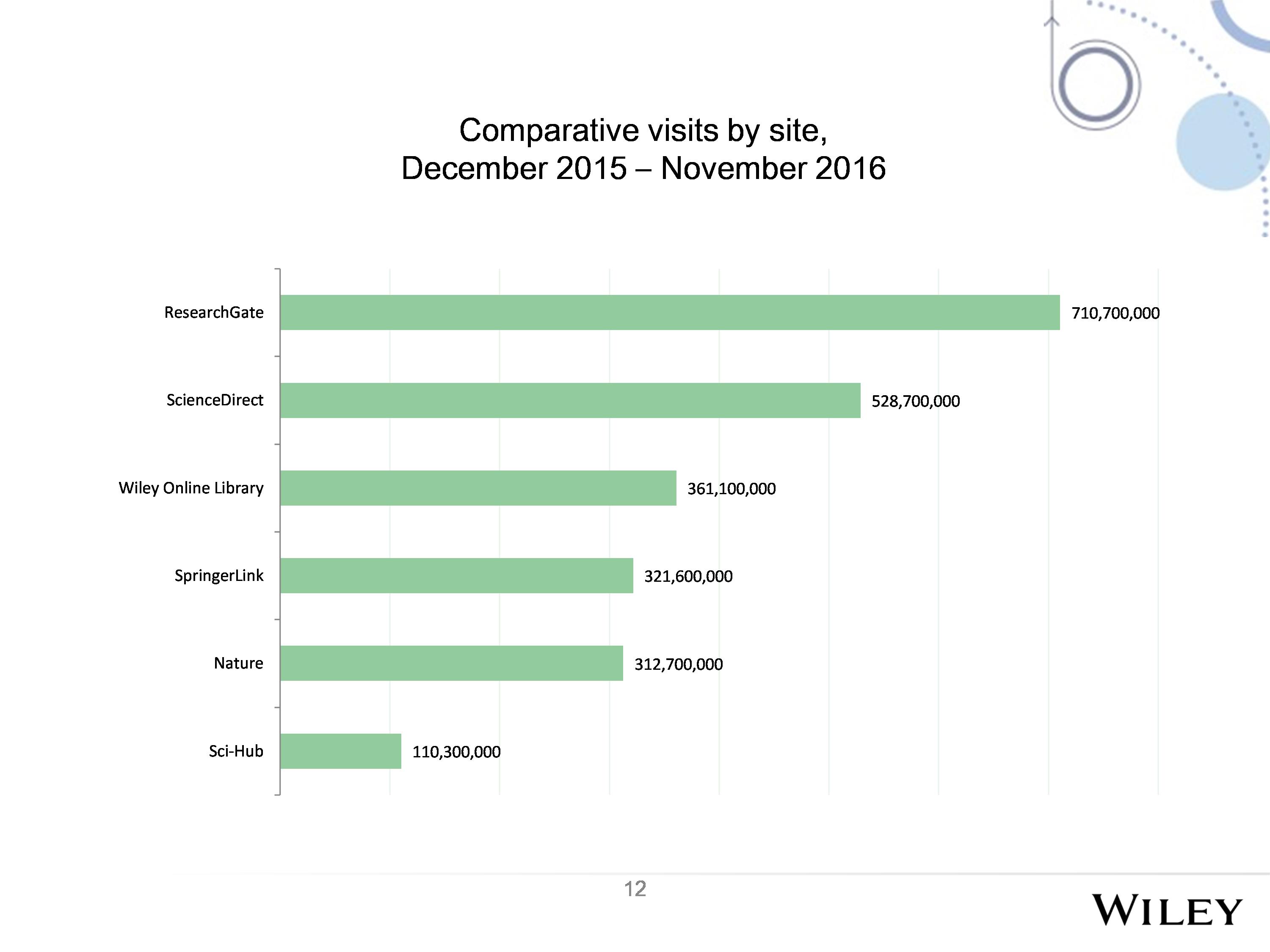
Researchers conspicuously are making dandy use of ResearchGate. Role of the reason is that ResearchGate is easy to employ. Gaining admission to large numbers of articles without the hassle of journal authentication systems is probable a large draw, as is access to papers from journals to which one'southward library does not subscribe. Several studies (examples here, here and here) have shown that these networks are actually used near exclusively for profile building, and the uploading and downloading of research manufactures.
Whatsoever academic will tell y'all that ResearchGate looms large in their daily life. Researchers receive massive numbers of unsolicited emails from ResearchGate on a daily ground, and while 90% of these will end up in the trash, the fact is that the remaining x% are actually useful – the brand of ResearchGate is front and eye in their minds.
Researchers particularly appreciate ResearchGate because they can hands follow who cites their articles, and they can follow references to find other articles they may find of interest. Researchers exercise non end to think almost copyright concerns and in fact, the platform encourages them, frequently, to upload their published papers.
Users probable pay little attending to whether the article they are accessing is being presented to them legally. At that place are, of form, many papers hosted on ResearchGate that are not violating copyright. Authors can and do often postal service the accepted manuscript version respecting any embargo policies and where such posting is immune for commercial purposes. ResearchGate provides links to the SHERPA/ROMEO database and provides the color designation for each journal to facilitate sharing policies

Publishers have been grappling with what to practice nearly SCNs, and ResearchGate in particular for close to a decade at present. ResearchGate is hosting a mix of cloth which includes a significant number of terminal published Version of Record articles, in violation of copyright. Further, there are reports that ResearchGate has stripped out metadata from papers, rebranded them, and contradistinct links in papers to indicate to their own hosted versions of papers, rather than the original journal. If truthful, these represent directly copyright infringements that go beyond the mere hosting and encouraging of copyrighted materials.
Publishers and societies have tried to find mutual ground and cooperative, mutually beneficial solutions for working with SCNs. This includes the STM'due south (International Association of STM Publishers) Sharing Principles, which have been signed-on to by several SCNs. It appears that such efforts have not succeeded with ResearchGate, which has resulted in the germination of the Coalition for Responsible Sharing, which includes publishers and societies ready to take action, ranging from legal requests asking ResearchGate to remove infringing articles, to litigation.
Milne, Spokesperson for the Coalition for Responsible Sharing has a meaning history in academic publishing across corporate and lodge publishing. In his 25 years he has worked at Elsevier, been Managing Managing director of publishing at the Royal Society of Chemistry, Global Publishing Manager for the Physical Sciences at Wiley, and currently is Senior Vice President in charge of journals publishing at the ACS.
Formation of the Coalition for Responsible Sharing
The Coalition for Responsible sharing currently includes five members, with several not-for-turn a profit publishers and research societies expected to join shortly: ACS, Elsevier, Wolters Kluwer, Wiley, and Brill.
According to Milne, the Coalition is a contempo coming together of publishers that are too members of STM. For over two years, STM has being attempting to discuss with SCNs an amicable solution on how publishers of all stripes could work together in a fully collaborative manner, with SCNs as part of the scholarly communication ecosystem.
Milne related that STM's role had been to piece of work with a broad range of publishers, representing them in discussions with ResearchGate in attempts to have all parties sign upward to the Voluntary Principles of Commodity Sharing on Scholarly Collaboration Networks. A dissever proposal, offering a route to providing automated processing of uploads, indicating to users whether an article can be shared privately, or publicly was also fabricated via a public letter of the alphabet. Unfortunately, these efforts take and then far yielded no results. Individual publishing houses are at present taking on the task outside of STM. The five publishers in the Coalition believe that the activities of ResearchGate undermine the integrity and sustainability of the scholarly advice system, Milne said.
The argument from the Coalition mentions that members are prepared to result have-down notices for content that violates copyright and that at least two publishers, Elsevier and the American Chemical Society, are pursuing further legal action.
Milne told me that members of the Coalition will issue take downward notices (an initial batch exceeding 100,000 to be sent imminently) to ResearchGate, and in fact ResearchGate has asked publishers to do just that if they discover articles that infringe copyright. The trouble is that this is a newspaper by paper solution. Coaliton publishers also want ResearchGate to aid explain to authors how to share research, while bearing in mind the demand to be copyright compliant.
According to Milne, ACS and Elsevier are taking farther legal activity against ResearchGate with the thought that even if infringing content is removed, more than will be uploaded, and that take downs practise not address the underlying pattern of behavior from ResearchGate.
"Copyrighted material should not exist made available for costless, unless at that place is a license in place, or the procedure aligns to the Voluntary Principles of Sharing" he said.
Information technology should also be stated that near content on ResearchGate does not infringe copyright; with that said, equally many every bit seven meg copyrighted articles are currently freely available on its platform.
The popularity of ResearchGate with users is a potential public relations trouble.
"This really is part of the core aspect, and why we were trying to work with ResearchGate towards an amicable solution," Milne said. He notes that the effect here is really that if ResearchGate were to work with publishers to keep their environment stiff and compliant, then there would be a significant benefit to researchers, and so information technology is not the publishers causing loss of access here, only ResearchGate. Publishers accept likewise been quite active on such initiatives equally How Can I Share Information technology, and authors are encouraged to share responsibly.
Asked whether there is a positive issue to researchers in this scenario, Milne said that publishers have been active in educating authors nigh how to share articles. Publishers are of course promoting Gold OA and the maximum ability to share that Gold allows. Researchers are now more than engaged in sharing activity. Researchers should benefit from publishers and ResearchGate working together.
ResearchGate is of course a for-profit entity, with vast amounts of venture capital funding. I asked Milne if there were any similarities to the early days of YouTube, and whether the ultimate solution would be a revenue-sharing arrangement along the lines of that site. Milne said that none of the publishers involved have explored revenue generating arrangements nether agreements to license content to ResearchGate. The primary business organisation of publishers is to accept ResearchGate abide past the Voluntary Principles and respect copyright.
Asked what ACS and Elsevier promise to get from the legal filing, Milne said, "Nosotros desire ResearchGate to finish scraping materials and modifying copyrighted materials. Nosotros don't want to encounter authors posting their content to ResearchGate in practiced faith, only to discover out that they accept to take information technology down later."
The Coalition essentially wants the courts to tell ResearchGate to work with publishers on collaborative solutions that are good for the research community. Currently, ResearchGate's lack of responsiveness has lead the coalition to conclude that the only option available is to issue accept down notices and pursue legal action in hopes that ResearchGate will comply.
As Chair of the Coalition, Milne invites publishers and scholarly societies who are interested in joining, should contact him direct or visit the Coalition's website.
Source: https://scholarlykitchen.sspnet.org/2017/10/06/researchgate-publishers-take-formal-steps-force-copyright-compliance/
0 Response to "Is It Okay to Upload Pdfs of Your Papers to Researchgate"
Post a Comment