Co2 Tank How Do You Know Size
Call a Draft Beer Adept Today - (800) 710-9939
Q: What are the main concerns when dealing with CO2?
A: CO2 tin be dangerous! Please utilise caution and always follow these steps:
- Always connect CO2 gas cylinder to reducing valve or regulator. Failure to do so could result in an explosion with possible death or injury when the cylinder valve is opened.
- Never connect gas cylinder directly to keg.
- Always secure gas cylinder in 'upright" position.
- Always keep gas cylinder away from heat.
- Never drop or throw CO2 gas cylinder.
- E'er ventilate subsequently CO2 leakage.
- Ever bank check the D.O.T. (Section of Ship) test date located on the cervix of the cylinder before installation. If over five (five) years, do not apply, return the gas cylinder to gas supplier.
- Never connect a product container unless there are two (2) safety mechanisms in the force per unit area arrangement.
- One at or on the CO2 regulator (the regulator supplied should be inclusive of such a safety mechanism).
- One at or on the product container coupler or in the pressure level gas line (the keg coupler should exist inclusive of such a condom mechanism).
- If information technology becomes difficult to breathe and your head starts to ache, abnormal concentrations of carbon dioxide may be present in the expanse. Close the main valve on the CO2 cylinder and get out the room immediately.
- Gas cylinders should exist stored in the coolest part of the establishment, preferably at 70 degrees, and deeply fastened in the upright position earlier the primary regulator is attached to the cylinder.
Q: What are the main components of a regulator and what exercise they do?
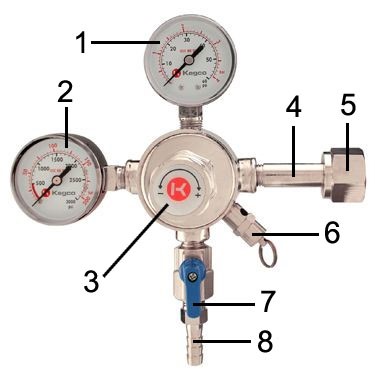
A: The principal components of a regulator are:
- Low pressure level approximate (reads the amount of internal keg force per unit area)
- High force per unit area judge (indicates existing pressure in the CO2 cylinder)
- Pressure level adjustment (before tapping the keg, spiral clockwise until low pressure approximate indicates the desired pressure)
- CO2 inlet nipple
- CO2 inlet nut
- Pressure relief valve
- Optional shut-off valve
- Outlet fittings
Q: At what force per unit area should I run my CO2 regulator?
A: For the standard five ft. run found in kegerators and near kegerator conversions, 10-12 PSI is recommended.
Longer draws in commercial establishments and jockey boxes require higher pressure level depending on the distance the beer needs to travel. Once fix, yous should monitor the regulator to ensure the pressure remains constant at the desired level.
CO2 gauge pressure level, temperature, and carbonation level reference chart
| Vol. Co2 | 2.one | 2.2 | ii.three | 2.iv | 2.5 | 2.half-dozen | ii.7 | 2.8 | 2.9 | 3.0 | 3.ane |
|---|---|---|---|---|---|---|---|---|---|---|---|
| Temp. F | psi | psi | psi | psi | psi | psi | psi | psi | psi | psi | psi |
| 33 | 5.0 | 6.0 | half dozen.9 | 7.9 | 8.8 | 9.eight | 10.vii | 11.vii | 12.6 | 13.6 | 14.5 |
| 34 | v.two | 6.two | vii.2 | 8.1 | ix.ane | x.1 | 11.i | 12.0 | 13.0 | 14.0 | 15.0 |
| 35 | five.half dozen | 6.six | vii.6 | eight.6 | ix.seven | 10.seven | 11.seven | 12.7 | thirteen.7 | xiv.8 | 15.eight |
| 36 | half dozen.1 | 7.1 | 8.2 | 9.2 | 10.2 | 11.iii | 12.iii | thirteen.4 | 14.4 | xv.5 | 16.5 |
| 37 | half dozen.6 | 7.half-dozen | viii.seven | nine.eight | x.8 | xi.9 | 12.9 | xiv.0 | 15.one | 16.one | 17.2 |
| 38 | seven.0 | eight.1 | 9.2 | x.iii | 11.3 | 12.iv | 13.five | 14.5 | fifteen.vi | 16.7 | 17.8 |
| 39 | 7.6 | 8.vii | nine.8 | 10.8 | eleven.9 | thirteen.0 | 14.1 | xv.2 | 16.3 | 17.iv | 18.v |
| 40 | eight.0 | 9.1 | 10.2 | xi.iii | 12.four | 13.v | fourteen.6 | 15.7 | xvi.8 | 17.9 | 19.0 |
| 41 | 8.3 | ix.4 | 10.half-dozen | eleven.7 | 12.eight | 13.nine | 15.ane | sixteen.ii | 17.3 | 18.4 | 19.five |
| 42 | 8.viii | 9.nine | 11.0 | 12.2 | thirteen.3 | 14.4 | xv.6 | 16.7 | 17.viii | 19.0 | twenty.1 |
| Vol. Co2 | 2.1 | 2.2 | ii.iii | 2.four |
|---|---|---|---|---|
| Temp. F | psi | psi | psi | psi |
| 33 | v.0 | 6.0 | six.nine | 7.9 |
| 34 | v.2 | 6.2 | 7.2 | viii.ane |
| 35 | 5.6 | 6.6 | seven.6 | 8.6 |
| 36 | 6.1 | 7.1 | viii.ii | ix.ii |
| 37 | vi.6 | 7.six | eight.7 | nine.8 |
| 38 | 7.0 | viii.one | ix.ii | x.three |
| 39 | vii.6 | 8.7 | ix.eight | 10.viii |
| 40 | 8.0 | 9.1 | ten.ii | xi.3 |
| 41 | 8.3 | 9.4 | ten.six | 11.7 |
| 42 | 8.8 | ix.9 | 11.0 | 12.2 |
| Vol. CO2 | 2.5 | 2.6 | two.7 | 2.8 |
|---|---|---|---|---|
| Temp. F | psi | psi | psi | psi |
| 33 | 8.viii | 9.eight | 10.7 | eleven.7 |
| 34 | 9.one | ten.one | xi.one | 12 |
| 35 | 9.seven | 10.vii | xi.7 | 12.7 |
| 36 | 10.2 | xi.3 | 12.3 | thirteen.4 |
| 37 | 10.8 | xi.9 | 12.9 | 14 |
| 38 | 11.three | 12.4 | 13.five | 14.5 |
| 39 | 11.9 | thirteen | 14.1 | 15.ii |
| 40 | 12.4 | 13.five | xiv.half dozen | 15.7 |
| 41 | 12.8 | 13.9 | 15.1 | sixteen.ii |
| 42 | thirteen.iii | xiv.iv | 15.6 | sixteen.seven |
| Vol. CO2 | 2.ix | iii | 3.1 |
|---|---|---|---|
| Temp. F | psi | psi | psi |
| 33 | 12.6 | 13.vi | xiv.5 |
| 34 | 13 | 14 | fifteen |
| 35 | xiii.vii | 14.8 | 15.8 |
| 36 | 14.4 | fifteen.v | sixteen.5 |
| 37 | fifteen.1 | 16.1 | 17.2 |
| 38 | 15.6 | 16.vii | 17.8 |
| 39 | 16.3 | 17.4 | 18.5 |
| xl | 16.8 | 17.ix | 19 |
| 41 | 17.3 | 18.4 | nineteen.v |
| 42 | 17.8 | 19 | twenty.ane |
Based on Information class "Methods of Analysis", American Lodge of Brewing Chemists, 5th Edition
- To account for pressure loss when you are opening your faucet, you lot tin can add one.v psi
- The values in this table presume sea-level altitude, beer specific gravity of 1.015, and beer alcohol content at 3.8% abw or iv.viii% abv. Values shown are in psig, or gauge pressure.
- It'due south of import to call up that carbonation is proportional to absolute pressure, not gauge pressure. Atmospheric force per unit area drops every bit elevation goes up. Therefore, the gauge pressure needed to achieve proper carbonation at elevations above body of water level must exist increased. Add 1 psi for every 2,000 feet above ocean level. For example, a retailer at ocean level would use 11.3 psi gauge force per unit area to maintain 2.five volumes of CO2 in beer served at 38F. That aforementioned retailer would need 13.3 psi guess pressure at 4,000 feet elevation to maintain two.5 volumes of CO2.
Q: How do I set my CO2 regulator?
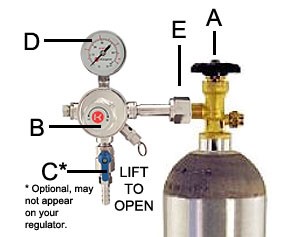
- Securely attach the regulator to the gas cylinder.
- Close the regulator's shut-off valve "C".
- Completely open the gas cylinder valve "A".
- Slowly turn the regulator adjustment "B" until the low pressure level gauge "D" displays the desired pressure. Plough clockwise to increase the pressure, and counter-clockwise to decrease the pressure.
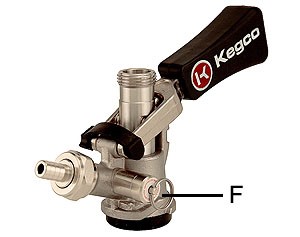
- Briefly pull the ring on the keg coupler'due south pressure level relief valve "F" to allow the pressure already in the keg to vent
- Open up the regulator shut-off valve "C" to allow gas to menses to the keg coupler.
- As the keg pressurizes, the needle on the low pressure gauge "D" volition drop temporarily until the pressure has equalized, and then will return to the signal yous previously set it at.
- Briefly pull the band on the keg coupler's pressure relief valve "F" over again to let gas to flow through the regulator to obtain a more accurate reading on the low pressure level guess "D".
- Re-check low pressure level gauge "D" and utilize regulator adjustment "B" to readjust if necessary until the desired pressure is displayed.
If you will exist dispensing multiple kegs that use the same CO2 pressure, you tin can split the gas menses to each keg using a two product regulator or an air line distributor. Withal, if yous will be dispensing multiple kegs with dissimilar pressure level requirements, secondary gas regulators will exist needed to adapt the pressure for each keg.
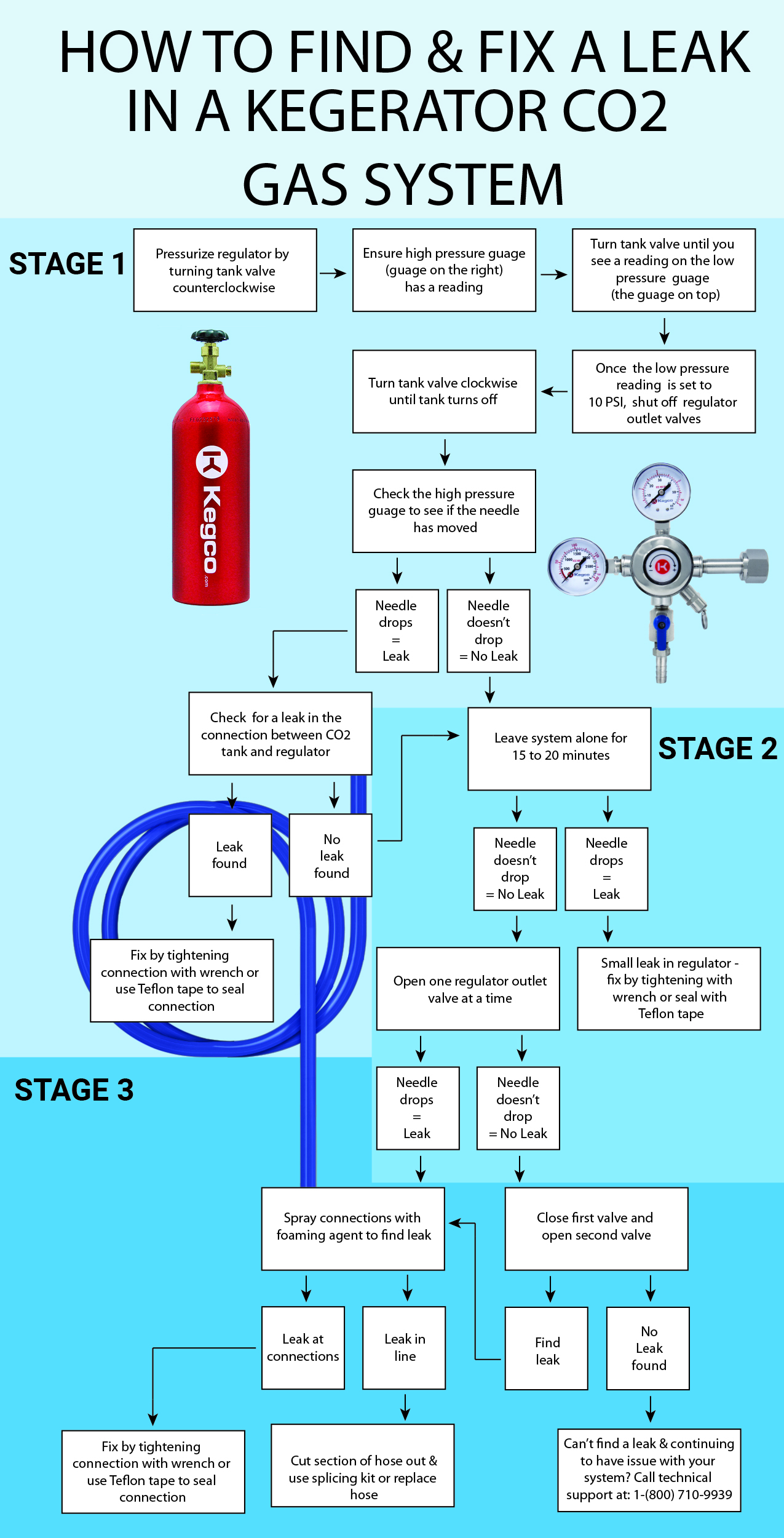
Q: How Do I Find a Leak in My Regulator?
Quick Guide
Video
More Information
Read our Step-past-Stride Guide for more than assistance.
Q: What size CO2 tank should I buy?
A: Information technology takes approximately 1/two lb. of CO2 to manipulate a 1/4 butt of beer. Depending on what size keg you volition be dispensing and what size CO2 tank y'all purchase, you tin can expect to dispense the following number of kegs:
| Keg | 2.5 lb. | 5 lb. | x lb. | xv lb. | 20 lb. |
|---|---|---|---|---|---|
| 3 Gallon | 12-15 | 25-31 | 51-63 | 77-95 | 103-127 |
| 5 Gallon | 7-11 | 15-22 | 31-44 | 46-66 | 62-87 |
| 7.75 Gallon | v-vii | x-14 | xx-28 | thirty-42 | 40-56 |
| 13.2 Gallon | 2-5 | 5-8 | 11-17 | 17-25 | 23-32 |
| 15.5 Gallon | 2-4 | five-seven | 10-xiv | 15-21 | twenty-28 |
Q: How do I replace an empty CO2 cylinder?
- Shut valve by turning "A" clockwise
- Unscrew adjustment screw "B" (counter-clockwise) every bit far every bit it will get.
- Remove regulator from empty cylinder at "Due east".
- Remove dust cap from new cylinder at "East". Open up and close valve "A" apace to blow dust from the outlet.
- With cylinder valve "A" in closed position, reattach regulator to cylinder at "E". Be certain to include the CO2 washer.
- Open up valve "A" all the way (this is important considering the cylinder valve seals in ii places).
- Readjust regulator force per unit area "B" and open optional valve "C".
Source: https://www.beveragefactory.com/draftbeer/faqs/co2+tank+faqs.shtml
0 Response to "Co2 Tank How Do You Know Size"
Post a Comment